
Heat Exchanger Repair in Leawood, KS
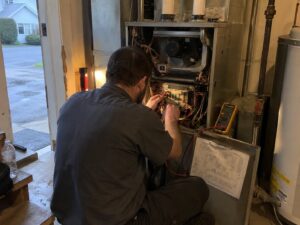
The heat exchanger is the part of your furnace that separates the air you breathe from the combustion gases — including carbon monoxide. When it cracks, that barrier is compromised, which makes a heat-exchanger problem the most safety-critical issue a furnace can have. It’s also the diagnosis some companies reach for too quickly to justify a sale. 7th Degree Heating and Air inspects with a borescope and confirms with an air-free carbon monoxide reading before we ever render a verdict, because a claim this serious has to be backed by evidence.
Why It Matters — and How We Confirm It
A cracked or corroded heat exchanger can allow carbon monoxide to mix into the warm air your blower circulates through the house. CO is colorless and odorless, so you can’t rely on noticing it. We don’t condemn a heat exchanger on a hunch: we inspect it directly with a borescope, measure carbon monoxide air-free at the supply registers, and look at the combustion picture as a whole. If it’s cracked, we’ll show you. If it isn’t, we’ll tell you that too — and we won’t push a replacement you don’t need.
Repair, Replace the Exchanger, or Replace the Furnace
- Often it’s a warranty part. Heat exchangers frequently carry a long manufacturer warranty — sometimes lifetime on the original owner — so the part itself may be covered even when labor isn’t. We check first.
- The labor is significant. Replacing a heat exchanger is labor-intensive, which is why on an older furnace the math often favors replacing the whole unit instead.
- We give you the honest comparison. Exchanger replacement versus a new furnace, with the warranty status and your furnace’s age factored in, so you can decide on real numbers.
Frequently Asked Questions
- What does the heat exchanger do?
- It transfers heat from combustion to your home’s air while keeping the two physically separated. The burner heats the metal exchanger, your blower moves household air across its outside, and the combustion gases — which include carbon monoxide — stay sealed inside and vent outdoors. That separation is the whole safety premise of a gas furnace.
- What are the signs of a cracked heat exchanger?
- Possible signs include soot around the furnace, a flame that flickers or shifts when the blower kicks on, a strong chemical or formaldehyde-like odor, unexplained headaches or nausea among household members, and CO detector activity. But cracks can be subtle, which is why a borescope inspection and air-free CO measurement are the reliable way to confirm one.
- Is a cracked heat exchanger really dangerous?
- Yes. A crack can let carbon monoxide enter the air your furnace circulates, and CO is colorless, odorless, and dangerous. That’s why we treat it as the most serious furnace finding there is — and also why we insist on confirming it with direct inspection rather than guessing, since the stakes cut both ways.
- Should I repair the exchanger or replace the furnace?
- It depends on the furnace’s age and warranty. The exchanger itself is often covered by a long manufacturer warranty, but the labor to replace it is substantial. On a newer furnace with a covered part, replacement of the exchanger can make sense; on an older unit, putting that labor toward a new, more efficient furnace is frequently the better value. We lay out both paths.
- What causes a heat exchanger to crack?
- Repeated heating and cooling cycles stress the metal over years, and an oversized furnace that short-cycles accelerates that fatigue. Restricted airflow that lets the exchanger overheat, corrosion, and simple age all contribute. It’s one more reason right-sizing and regular maintenance matter — they extend the life of the most safety-critical part.
Contact 7th Degree Heating and Air
Serving Leawood, Overland Park, Prairie Village, Mission, Merriam, and Lenexa with honest heat-exchanger diagnosis and 24/7 emergency service.
- Emergency Line (24/7): (913) 354-6552
- Address: 12720 Catalina St, Leawood, KS 66209
- Email: info@7thdegreeheatingandair.xyz
- Johnson County Class “DM” Mechanical License: DM-24-11873
- EPA Section 608 Universal: EPA-608-U-457921
Office Hours
- Emergency Service: 24 hours a day, 7 days a week
- Office Staff: Monday – Saturday, 9:00 AM – 5:00 PM
- Sunday: By appointment
- Closed: Holidays (emergency line always active)