
Indoor Air Quality Services in Leawood, KS
Johnson County asks two opposite things of your home’s air in the same year. Summers are humid enough that the air feels heavy and basements turn muggy; winters are dry enough to crack woodwork and skin. A good indoor-air-quality setup handles both ends — and accounts for the local WaterOne hard water that quietly destroys humidifier components on a schedule generic equipment doesn’t expect. 7th Degree Heating and Air designs, installs, and services air-quality equipment tuned to how this climate and this water actually behave.
The Local Air-Quality Picture
In a mixed-humid Climate Zone 4A summer, controlling moisture is half the comfort battle. Excess humidity makes 74°F feel sticky, feeds mold in basements, and forces your AC to work harder. In winter, the opposite problem appears as the heat runs and indoor air dries out. Layered on top is water chemistry: WaterOne treats its supply but it still lands in the moderately-hard to hard range (commonly cited around 5–8 grains per gallon), which scales humidifier pads and steam canisters faster than rated and builds mineral and biofilm deposits in condensate lines. And because most homes here heat with gas, carbon monoxide testing belongs in any serious air-quality conversation.
Our Indoor Air Quality Services
Duct Cleaning
Removal of dust, debris, and biological buildup from ductwork — especially worthwhile after renovation, water intrusion, or years without service.
Humidifiers
Whole-home bypass and steam humidifiers to fight winter dryness, with hard-water-aware service intervals so pads and canisters actually last.
Dehumidifiers
Whole-home dehumidification for the muggy-basement and clammy-house problem that humid Johnson County summers create.
Air Purifiers
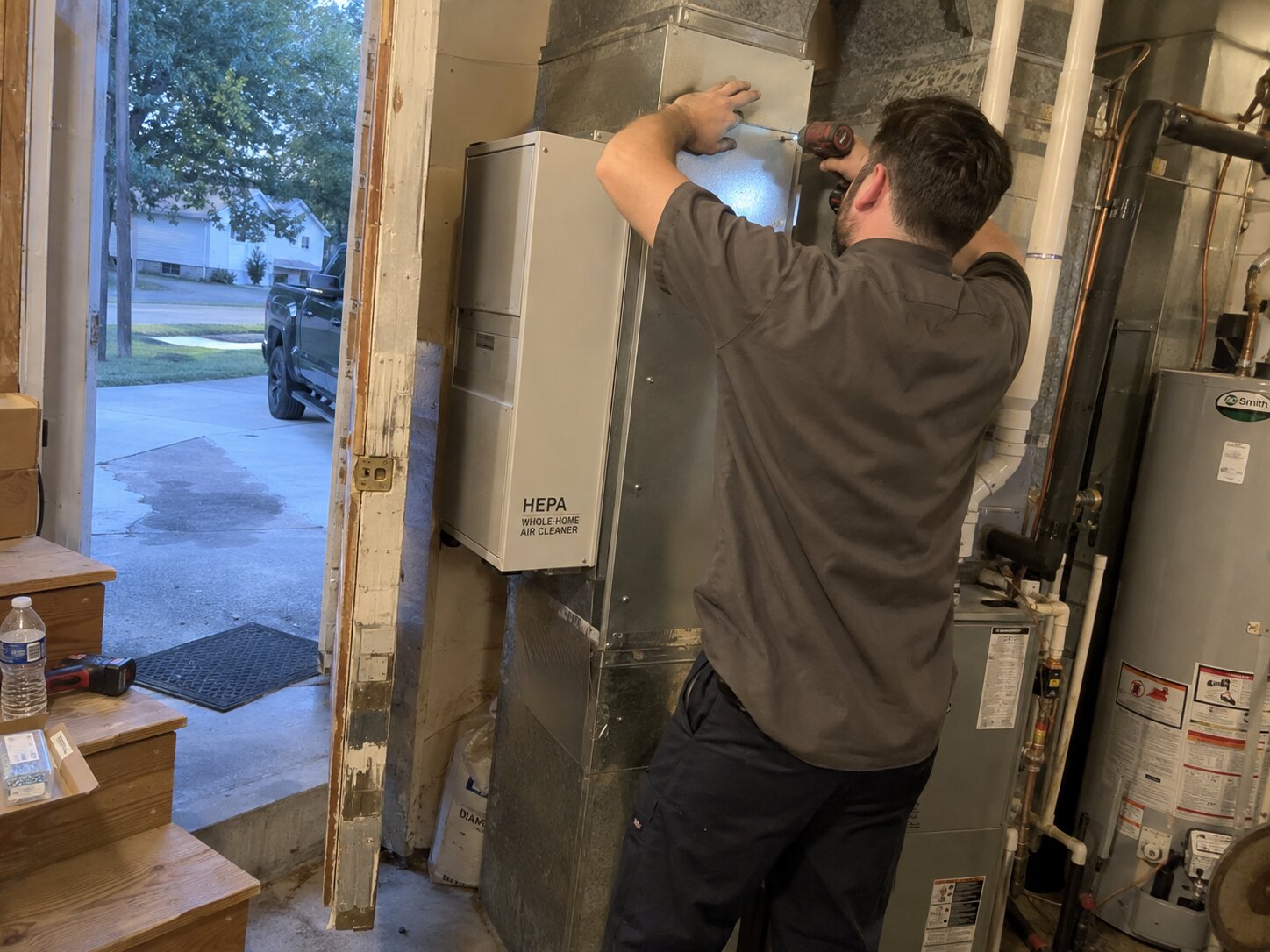
Whole-home filtration and purification for allergens, dust, and particulates, integrated with your existing system.
UV Light Treatment
UV-C coil treatment to control mold and biological growth on the evaporator coil — a real concern in humid-summer climates.
Air Filter Replacement
The right MERV rating for your system and household, balancing filtration against the airflow restriction a too-dense filter causes.
Carbon Monoxide Testing
Air-free CO measurement and combustion safety checks on gas appliances, plus guidance on detector placement.
Frequently Asked Questions
- Why would I need both a humidifier and a dehumidifier in the same house?
- Because Johnson County’s climate runs to both extremes. Summers in mixed-humid Zone 4A are humid enough that a whole-home dehumidifier keeps basements and main floors from feeling clammy, while winters get dry enough as the furnace runs that a humidifier protects woodwork, instruments, and comfort. Many local homes benefit from both, controlled seasonally.
- How does local hard water affect my humidifier?
- WaterOne supply, even after treatment, carries enough mineral content (roughly 5–8 grains per gallon) to scale humidifier pads and steam canisters faster than their rated life. That’s why we set service intervals around local water rather than the manufacturer’s optimistic default — a neglected pad in this water becomes a clogged, inefficient one in well under a year.
- What MERV rating filter should I use?
- For most homes here, a MERV 11 to 13 filter is the sweet spot — it captures fine particulates and allergens without choking airflow. Going too dense (a thick high-MERV filter on a system not designed for it) raises static pressure, strains the blower, and can actually hurt performance. We match filter selection to your specific air handler’s capacity.
- Do I really need a whole-home dehumidifier?
- If your AC keeps the temperature down but the house still feels damp, or your basement is consistently muggy in summer, yes — it’s a common and fixable problem in our humid climate. A whole-home dehumidifier removes moisture independent of the cooling cycle, so you get comfort without overcooling the house just to dry it out.
- Why is carbon monoxide testing part of indoor air quality?
- Most Johnson County homes heat with gas, and modern, well-sealed homes give combustion byproducts fewer ways to escape. A cracked heat exchanger or a venting problem can introduce carbon monoxide — colorless and odorless — into the air you breathe. Air-free CO testing on your gas appliances, plus detectors on every level, is basic safety.
Contact 7th Degree Heating and Air
Serving Leawood, Overland Park, Prairie Village, Mission, Merriam, and Lenexa with indoor-air-quality solutions built for Johnson County’s humidity, dryness, and hard water.
- Emergency Line (24/7): (913) 354-6552
- Address: 12720 Catalina St, Leawood, KS 66209
- Email: info@7thdegreeheatingandair.xyz
- Johnson County Class “DM” Mechanical License: DM-24-11873
- EPA Section 608 Universal: EPA-608-U-457921
Office Hours
- Emergency Service: 24 hours a day, 7 days a week
- Office Staff: Monday – Saturday, 9:00 AM – 5:00 PM
- Sunday: By appointment
- Closed: Holidays (emergency line always active)